
Plant-Based Pastry Butter: What to Look For Before You Commit to Lamination at Scale
For a bakery, patisserie or pastry program, changing your butter or pastry fat is not a small decision. The right product affects everything from dough handling and production speed to lamination, finished yield and customer satisfaction.
If you are looking for a plant based pastry butter or a reliable vegan pastry butter for commercial volume, the label is only the starting point. You need to know how the fat behaves in your kitchen, at your bench temperature and through your full production cycle.
Here is a practical buyer’s checklist for comparing pastry fats, followed by a simple way to trial a new product without putting your production schedule at risk.
1. Start with fat content
Fat content is one of the first specifications to check when comparing a plant based butter supplier.
Traditional butter used for lamination generally contains a high percentage of fat. A higher-fat pastry fat usually means less water in the product, which can help support cleaner layers, better flakiness and more predictable dough development.
For commercial pastry applications, compare:
- Total fat percentage
- Water content
- The intended use on the product specification
- Whether the product is designed for general baking or pastry work
- How the product performs through folds, sheeting and baking
Nuttelex Bakers Blend is an 80% fat plant-based baking product in a 15kg food-service pack. It is Nuttelex’s highest-fat 15kg food-service option and a sensible place to start a pastry or laminated-dough trial. Before committing, confirm technical suitability with your supplier, including recommended working temperature, melt point and any lamination handling guidance.
Nuttelex Buttery Blend contains 65% fat and is designed as a versatile buttery-style product for baking, cooking and spreading. It may suit pastry applications where melt, flavour and general baking performance are the priority, while Bakers Blend may be the more practical first trial if you want to compare a higher-fat Nuttelex option.
2. Look beyond fat content: melt point and plasticity
A pastry fat can have the right fat percentage and still be difficult to work with if it is too brittle when cold or too soft at the bench.
What you are looking for is plasticity: the ability to flatten, stretch and fold without cracking, splitting or greasing out. The fat should move with the dough rather than breaking into pieces or disappearing into it.
Ask your supplier:
- What is the recommended working temperature?
- Is there a melting range or technical handling guide?
- Should the product be used directly from refrigeration?
- Does it require tempering before sheeting?
- Is it suitable for your retarder, sheeter and proving schedule?
For a consistent trial, keep the dough and pastry fat at similar temperatures. Nuttelex product information recommends refrigerated storage, with the Bakers Blend product handled cold for pastry work. Your own kitchen conditions will still matter, particularly during summer or in a warm production area.

3. Test workability at your actual bench temperature
A product that performs well in a cool test kitchen may behave differently during a busy morning production run.
Bench temperature, flour temperature, dough temperature, sheeter speed and rest times all influence lamination. This is why a proper trial should happen in the same environment where you plan to use the product.
Watch for:
- Cracking at the edges of the fat during the first fold
- Fat leaking from the dough during sheeting
- Uneven thickness across the sheet
- Excessive resistance through the sheeter
- Dough tearing around corners
- Layers merging during the final roll
- Greasy or heavy finished pastry
You should also check how much bench flour is needed. Excess flour can affect dough adhesion and finished texture, while a fat that is too soft may create extra cleaning time and production waste.
The best plant based butter for your bakery is not simply the one with the most attractive specification. It is the one your team can handle repeatedly, within your normal temperature and time controls.
4. Check consistency from batch to batch
Commercial pastry production depends on repeatability. A product may perform well once, but can you expect the same results across different deliveries and production days?
Before committing to a new vegan butter supplier, build consistency checks into your trial process. Record:
- Product name and exact SKU
- Batch or lot number
- Delivery date
- Storage temperature
- Dough temperature at mixing
- Fat temperature at lock-in
- Rest time between folds
- Number of folds
- Sheeting thickness
- Proofing time and temperature
- Finished weight and dimensions
- Bake time and temperature
- Final appearance and eating quality
This gives your head baker and procurement team something more useful than a general opinion. It creates a repeatable record that can be compared with your current product.
It is also worth checking the supplier’s ability to maintain availability. A pastry fat that works well but cannot be supplied consistently can create just as much disruption as a product that does not perform.
5. Compare yield and cost per usable kilogram
The lowest invoice price does not always equal the lowest production cost.
When comparing a plant based food service product, calculate more than the cost per kilogram on the invoice:
Cost per kilogram = pack price ÷ pack weight
Then adjust for practical yield:
- How much product is lost during portioning?
- Is the fat easy to cut or weigh accurately?
- Does it require additional flour or bench time?
- Are more pastries rejected because of uneven lamination?
- Does the product reduce rework or improve finished volume?
- Can your team use the full pack within the recommended storage period?
A 15kg pack can be attractive for a high-volume bakery because it reduces frequent ordering and packaging waste. However, you should still plan storage carefully and confirm your usage rate before ordering multiple packs.
For current product information, see the Nuttelex Bakers Blend 80% Fat 15kg listing and the Nuttelex Buttery Blend 65% Fat 15kg listing.
Nuttelex Bakers Blend or Buttery Blend?
Both products are plant-based and dairy-free, but they serve slightly different commercial purposes.
Choose Bakers Blend when you are prioritising:
- High-fat pastry and biscuit applications
- Nuttelex’s highest-fat 15kg food-service option
- A sensible starting point for a commercial pastry or lamination trial, subject to supplier confirmation on technical suitability
Consider Buttery Blend when you are prioritising:
- General baking
- Buttery flavour
- Melt and spreadability
- Sauces, finishing and cooking
- Pastries where highly defined lamination is not the main requirement
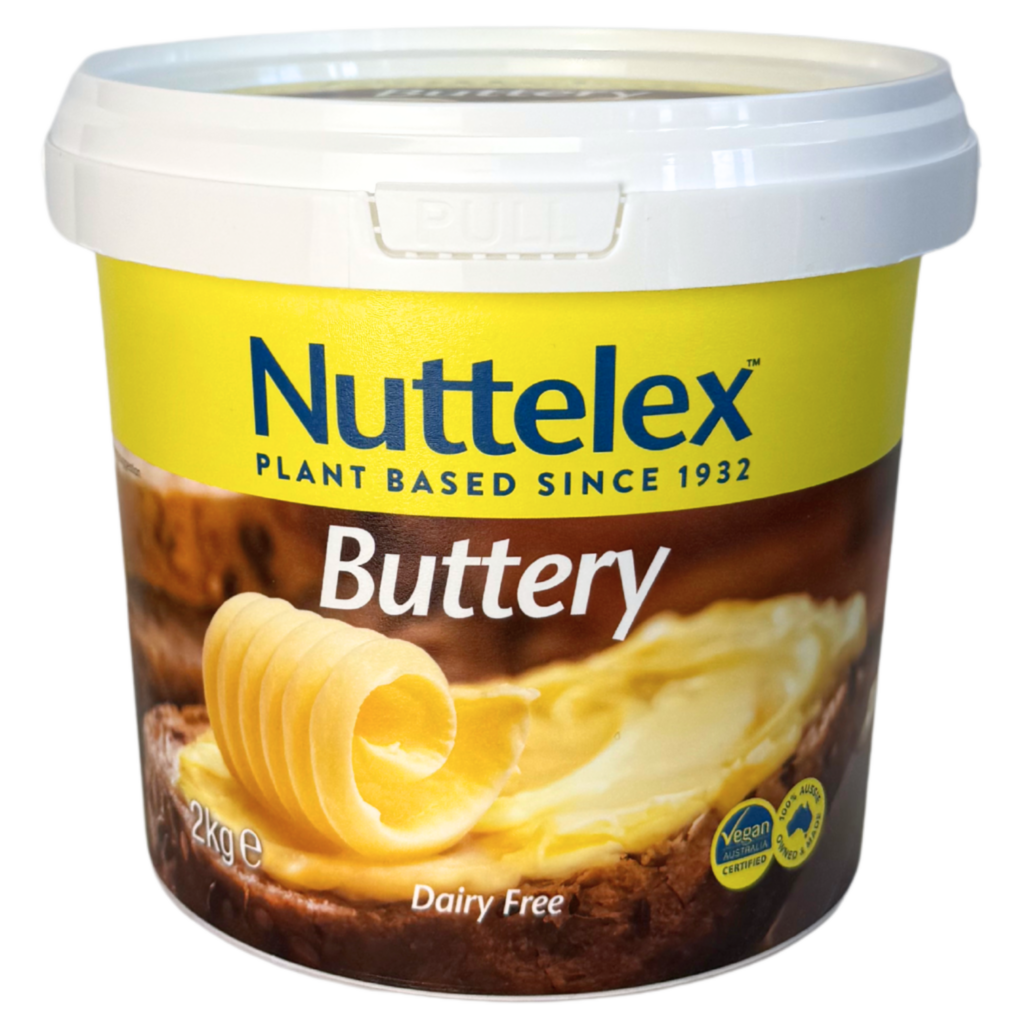
The 2kg Nuttelex Buttery Blend tub can be useful for smaller kitchen applications and bench testing, while the 15kg food-service formats are better suited to ongoing commercial production. Always confirm that the product you trial matches the SKU and format you intend to purchase at scale.
How to trial a new butter in one production run
You do not need to change your entire bakery to test a new product. A controlled trial can fit into one planned production run.
Before production
- Choose one product, such as croissants or Danish pastry.
- Keep the dough formula, hydration and yeast level unchanged.
- Weigh out enough pastry fat for a small, representative batch.
- Record the fat and dough temperatures.
- Schedule the trial during a normal production window, not during your busiest service period.
- Mark the trial trays clearly so the team can track the results.
During lamination
- Use your usual lock-in thickness and fold pattern.
- Note whether the fat cracks, smears or stretches cleanly.
- Record any changes to sheeter settings or bench rest.
- Keep an eye on dough temperature after each fold.
- Avoid making several process changes at once.
After baking
Compare the trial batch with your current product or a recent standard batch. Look at:
- Finished height
- Layer definition
- Flakiness
- Shape and spread
- Colour
- Internal crumb
- Eating quality
- Baked weight
- Waste and rejects
- Team feedback
- Labour or cleaning time
If the product performs well, repeat the trial on a second production day before committing to a full changeover. This helps confirm that the result was not caused by a particularly cool day, a different flour batch or an unusually experienced operator.

Frequently asked questions
Is plant-based butter suitable for croissants?
Yes, but not every plant-based butter is designed for the same job. For croissants and other laminated doughs, look for a high-fat product with workable plasticity and clear commercial baking guidance. Within the Nuttelex range, Bakers Blend 80% Fat is the highest-fat 15kg option and a sensible place to begin a trial, but you should confirm working temperature, melt point and lamination guidance with your supplier before committing.
Can I use Buttery Blend for lamination?
Buttery Blend can be used in pastry applications, but its 65% fat content makes it different from the higher-fat Bakers Blend. Test it carefully if flavour and melt are important, and confirm technical suitability for your process with your supplier before committing to either product for structured lamination.
What should I ask a vegan butter supplier?
Ask about fat content, water content, recommended working temperature, storage, shelf life, batch consistency, pack size and availability. Also ask whether the product is used by bakeries for croissants, puff pastry or Danish production.
Where can bakeries buy Nuttelex in bulk?
The Plant Pantry supplies Nuttelex and other plant-based food-service products to professional kitchens across Australia. Apply for wholesale access to view trade options and simplify your ordering.
Ready to trial a better commercial pastry fat?
Choosing a plant based pastry butter is a production decision, not just a purchasing decision. Compare the technical specifications, test the product in your real workflow and measure the result against yield, consistency and labour.
The Plant Pantry can help your bakery source Nuttelex Bakers Blend, Buttery Blend and a broader range of wholesale vegan food suppliers through one Australia-wide plant-based distribution partner.
Visit The Plant Pantry to access wholesale plant-based food service products.