
How Much Granola Should You Actually Order? Portion Math for Busy Cafes
If you’re serving granola in bowls, parfaits or takeaway breakfast pots, a practical starting point is 60–80g per serve. That means one 2kg Kitchen Remedy bag gives you roughly 25–33 serves, depending on how generous your portions are.
That little bit of maths makes ordering much easier. You can work from actual weekly sales instead of guessing, over-ordering or discovering at 7.15am that the last scoop has just gone into a takeaway cup.
Kitchen Remedy vegan gluten-free granola is made for this sort of café service. It comes in a 2kg bulk bag, has a six-month shelf life, and gives you a consistent product to portion across breakfast bowls, parfaits and snack pots.
Start with your actual portion size
Granola portions can creep up quickly. One team member uses a tidy scoop, another gives the bowl “just a little more”, and suddenly your planned 60g serve is closer to 90g.
For most café operations, these are useful benchmarks:
| Granola portion | Serves per 2kg bag | Best suited to |
|---|---|---|
| 60g | About 33 serves | Parfaits, yoghurt pots and lighter breakfast bowls |
| 70g | About 28 serves | A balanced café bowl with fruit and yoghurt |
| 80g | 25 serves | Large, filling bowls or granola-forward serves |
The formula is straightforward:
Total granola required = number of serves × portion size in grams
Then allow a little extra for spillage, staff sampling, broken packaging and the occasional enthusiastic scoop. A 5–10% operating buffer is sensible for a busy café.
Example: 20 bowls a day
Let’s say you sell 20 granola bowls per day, six days a week.
- 20 serves × 6 days = 120 serves per week
- 120 serves × 70g = 8,400g
- Add a 10% buffer = 9,240g
- Round up to the next 2kg bag size = 10kg, or five bags
At a 60g portion, the same café would use around 7.2kg before the buffer. At 80g, it would use 9.6kg before the buffer.
That’s a meaningful difference over a month, especially when granola is paired with plant-based yoghurt, fresh fruit, nut butter and other premium ingredients.
What does 60–80g look like in the bowl?
The weight is more reliable than volume, because granola density varies. A scoop of chunky granola won’t measure exactly the same as a scoop of finer pieces.
As a rough café guide:
- 60g is around half a cup for many granolas
- 70g is a generous half-cup
- 80g is closer to two-thirds of a cup
But don’t set your kitchen standard by eye. Take your serving scoop, fill it as your team normally would and weigh it on a digital scale.
Do this three times:
- Fill the scoop level.
- Weigh the granola.
- Empty and repeat.
If the results are 62g, 68g and 74g, your “70g scoop” isn’t consistent enough yet. Try a different scoop or mark the correct fill line. It’s a small job during prep and saves plenty of product over a busy week.
We’d also recommend weighing the finished bowl during your setup process. The granola may be right, but the yoghurt, fruit and toppings can change the perceived size of the serve. A consistent bowl makes food costing easier and gives customers the same breakfast every time.
Why the Kitchen Remedy 2kg bag works for café service
Small retail packs are fine for the pantry at home. In a café, they create extra packaging, extra opening and more chances for the product to disappear into the back of the dry store.
The Kitchen Remedy 2kg format gives you:
- A practical food-service quantity
- Fewer bags to open during the week
- Easier stocktake and ordering
- More consistent portion control
- Less packaging per kilogram
- Enough product for multiple menu applications
And the six-month shelf life gives you breathing room. You don’t need to order a new bag every time you run a weekend special or add a breakfast pot to the cabinet. You can plan stock around your real sales pattern, provided the product is stored as directed and kept protected from heat and moisture.
Once opened, keep the bag sealed between services or transfer the granola into an airtight food-safe container. Moisture is the enemy of crunch. A dry store away from steam wands, dishwashers and direct sunlight is a much better home than the bench beside the coffee machine.
Make the crunch work harder
Kitchen Remedy original granola has a flavour profile that suits more than a standard bowl of yoghurt. It’s hand-baked with toasted seeds and grains, goji berries, cranberries and cinnamon, with a warm, lightly spiced finish.
The texture is just as useful in service. It has a proper toasted crunch that holds up in milk and yoghurt instead of turning soft the moment it hits the bowl.
That gives you a few easy ways to use one product across the day:
Breakfast bowls
Use a 70–80g serve as the base, then add plant-based yoghurt, seasonal fruit and a spoon of nut butter. For a smaller breakfast or lighter menu item, bring the granola down to 60g and let the fruit provide volume.
Parfaits
Layer yoghurt, fruit and granola in a clear cup. Put some granola through the middle and finish with a smaller amount on top. The middle layer softens slightly while the top stays crisp, giving customers two textures in the same serve.
For a parfait with several other components, 60g is usually enough. If granola is the feature rather than a garnish, 70g gives the cup a more generous feel without pushing usage too high.
Takeaway breakfast pots
For takeaway, add the granola as the final layer or pack it separately if the pot will sit for a while. A separate small sachet or lidded cup keeps the crunch at its best, particularly for delivery orders and cabinet products that may be refrigerated overnight.
Snack pots
A 30–40g portion can work for a smaller snack pot with fruit, yoghurt or stewed apple. That’s below the 60–80g bowl guide, but it can be a useful way to extend the range without pretending every customer wants a full breakfast serve.
The chocolate option for dessert-style bowls
If you want a second flavour for a breakfast special or dessert-style bowl, Kitchen Remedy also has a vegan gluten-free chocolate granola in a 2kg bulk bag. It combines toasted seeds and grains with roasted hazelnuts, dark chocolate drops and cinnamon.
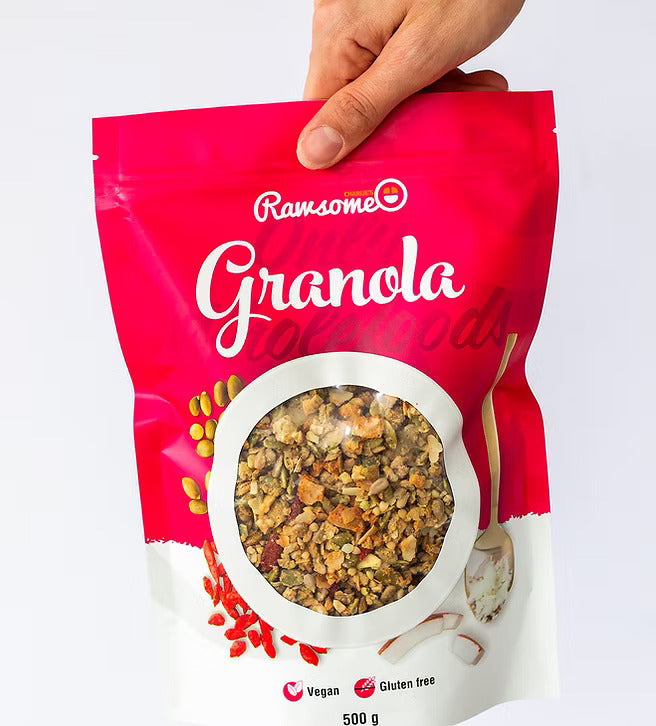
The chocolate version works particularly well with thicker plant-based yoghurt, banana, chocolate sauce or a scoop of vegan ice cream. You can view the Kitchen Remedy vegan gluten-free chocolate granola 2kg on Plant Pantry.
Keep the original and chocolate versions clearly labelled in dry storage. During a rush, a brown bag and a plain bag can look surprisingly similar when someone is reaching into the cupboard with one hand while calling out coffees with the other.
A simple weekly ordering method
Use this process every week:
- Check the number of granola bowls and parfaits sold.
- Add any snack pots or retail portions.
- Multiply total serves by the actual portion weight.
- Add 5–10% for normal kitchen loss.
- Divide by 2,000g.
- Round up to a whole number of 2kg bags.
For example:
- 90 weekly serves at 60g = 5.4kg
- Add 10% buffer = 5.94kg
- Order three 2kg bags
Or:
- 150 weekly serves at 80g = 12kg
- Add 10% buffer = 13.2kg
- Order seven 2kg bags
Track this for three or four weeks and you’ll have a much clearer picture of your normal usage. You may find weekday breakfasts sit around 60g while your weekend bowls are closer to 80g. That’s useful information for both food costing and ordering.
The quick answer
For a café using Kitchen Remedy granola:
- 60g per serve: around 33 serves per 2kg bag
- 70g per serve: around 28 serves per bag
- 80g per serve: 25 serves per bag
- Add 5–10% to your weekly order for practical kitchen waste
- Store it airtight and dry to protect the crunch
- Use the six-month shelf life to plan stock instead of panic-ordering
If you’re looking for gluten free vegan granola wholesale, healthy wholesale snacks Brisbane venues can keep on hand, or vegan healthy treats wholesale for your café cabinet and breakfast menu, order through Plant Pantry. You can get Kitchen Remedy granola alongside everything else your plant-based kitchen needs.